Measuring trailer tongue weight
Three ways to measure trailer tongue weight: a dedicated tongue weight scale, the bathroom scale method, and using a CAT scale at a truck stop.
Aim for tongue weight at 10 to 15% of total trailer weight. Below 10% and the trailer sways. Above 15% and the truck squats, the front end lightens, and steering and braking suffer. For a 7,000 lb travel trailer, that’s 700 to 1,050 lb on the ball. Measuring is the only way to know your number. Guessing gets people in trouble.
Three methods that actually work: a dedicated tongue weight scale (most accurate, $200), the bathroom scale and pipe trick (free, surprisingly accurate), or weigh at a CAT Scale ($14, fast, official numbers).
Method 1: Tongue weight scale
A Sherline 1,500 lb or 5,000 lb tongue weight scale ($120 to $200) is purpose-built. Set it under the trailer tongue, lower the trailer tongue jack onto the scale, disconnect from the truck, read the number.
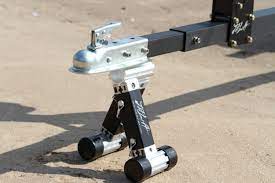
Steps:
- Park the loaded trailer on level concrete. Truck still hitched.
- Place the tongue weight scale under the coupler (most scales have a ball or a flat plate that the coupler sits on).
- Lower the trailer tongue jack so weight transfers from the truck to the scale.
- Unhitch the trailer fully from the truck.
- Read the scale.
Sherline scales handle up to their rated capacity. Don’t try to measure a 1,200 lb tongue on a 1,000 lb scale.
For travel trailers and boat trailers up to 5,000 lb, this is the right tool. Anything bigger usually needs a CAT Scale.
Method 2: Bathroom scale and pipe method
Free version for people who don’t own a tongue weight scale and don’t want to drive to a truck stop. Works for tongue weights up to about 500 lb.
What you need:
- One bathroom scale
- Two pipes or short 2x4 blocks (about 12 inches each)
- A solid level surface
Setup:
- Stack one pipe on the bathroom scale.
- Place a sturdy board across the pipe and a second pipe (or a wood block at the same height as the pipe-on-scale).
- Lower the trailer tongue jack onto the board, centered between the two pipes.
- The scale reads about half the tongue weight (the other half is on the second pipe). Multiply scale reading by 2.
Or simpler version for lower-weight trailers (under 200 lb tongue): just lower the trailer tongue directly onto a sturdy bathroom scale and read.
Accuracy is roughly +/- 20 lb. Good enough for most utility trailers and small boat trailers. Not good enough for travel trailers.
Method 3: CAT Scale
CAT Scales sit at most truck stops (Pilot, Flying J, Love’s, TA). $14 per weigh, accurate to under 20 lb on a multi-thousand-pound load. This is how trucking professionals weigh.
Procedure:
- Drive the truck onto the scale, alone (trailer left at home or unhitched).
- Get a ticket: that’s truck weight.
- Hitch up the loaded trailer.
- Drive back onto the scale: truck front axle on pad 1, truck rear axle on pad 2, trailer axles on pad 3.
- Tongue weight = combined truck weight with trailer hitched minus truck weight alone.
This also gives you the trailer’s gross weight (pad 3 reading) and the total combined weight, which is useful for confirming you’re under your truck’s rated towing capacity.
Most CAT Scales offer a smartphone app (CAT Scale Inc.) that lets you start the weigh without going inside.
What tongue weight should be
| Trailer type | Tongue weight target |
|---|---|
| Conventional bumper-pull | 10% to 15% of trailer weight |
| Travel trailer | 12% to 15% |
| Boat trailer | 5% to 7% (lower; design difference) |
| Cargo trailer | 10% to 15% |
| Fifth-wheel | 15% to 25% of trailer weight (pin weight, not tongue) |
| Gooseneck | 20% to 30% (pin weight) |
A 6,000 lb travel trailer should have 720 to 900 lb on the tongue. Less than 600 lb and you’re risking sway. More than 1,000 lb and you’re hammering the truck.
Adjusting tongue weight
Too light: move cargo forward (toward the front of the trailer). Especially heavy items like batteries, full water tanks (for travel trailers), tool boxes.
Too heavy: move cargo back, or rebalance heavy items closer to the trailer’s axle (not behind it).
For travel trailers, water and propane both add weight. A full freshwater tank (typically 30 to 60 gallons, 250 to 500 lb) and two full LP tanks (60 lb each) move the math. Always weigh with the trailer in the state you’ll tow it.
Weight distribution hitches
Weight-distribution hitches (Equal-i-zer, Andersen, Reese Steadi-Flex, Curt TruTrack) redistribute tongue weight from the rear axle of the truck to all axles. They don’t change actual tongue weight; they change how it’s carried. You still need to measure tongue weight to size and set up the WD hitch properly.
Set up a WD hitch with about 50% of the rear axle squat restored (compare truck height with and without trailer hitched). The hitch manual will spell out the spring bar tension procedure for your model.
Hitch class and tongue weight
The hitch class you have caps how much tongue weight you can carry. Check the receiver tag on your truck.
| Class | Max GTW | Max tongue weight (weight-carrying) | Max with WD hitch |
|---|---|---|---|
| I | 2,000 lb | 200 lb | n/a |
| II | 3,500 lb | 300 lb | n/a |
| III | 6,000 lb | 600 lb | 1,000 lb (10,000 GTW) |
| IV | 10,000 lb | 1,000 lb | 1,400 lb (14,000 GTW) |
| V | 12,000 lb | 1,200 lb | 1,700 lb (17,000 GTW) |
The lowest-rated component in the system sets the limit. A Class III hitch on a Class IV ball mount is still rated Class III.
When to measure
Every trailer load if the cargo changes significantly. Before any long trip. After major rearrangement of contents. The first time you load any new trailer.
Tongue weight doesn’t change much trip to trip if you load the same way every time. After you’ve weighed a few times and know your typical number, casual checks are fine. New trailer or new load type: measure.