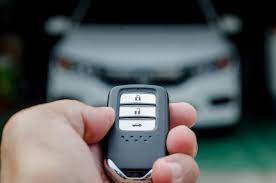
Programming a car key fob
Try the DIY ignition-cycle programming method for older fobs, replace the CR2032 battery first, and know when a dealer or locksmith is required.
Try the battery first. About 60% of dead key fobs come back to life with a fresh $3 CR2032 coin cell. If that doesn’t fix it and the fob is for a 1995 to roughly 2012 vehicle without a chip transponder for the start function, the ignition-cycle DIY programming method below often works. Anything newer than that, or any fob that also starts the engine (transponder or push-button), needs dealer software or a locksmith with the right scan tool, typically $75 to $300.
The remote-only (lock, unlock, panic, trunk) functions are easier to program than the start-the-engine functions, because the immobilizer chip handshake has nothing to do with the remote radio signal.
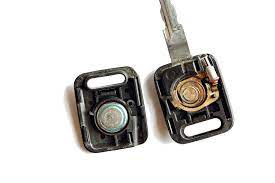
Step 1: Check the battery
Pop the fob open (most slide open with a coin slot, some snap apart with a small screwdriver in a seam). Inside is a CR2032 button battery in most cases. Some Honda and Lexus fobs use CR2025 or CR1620.
Pull the old battery. Wipe the contacts. Pop in a fresh one. Snap the fob closed. Test.
A typical fob battery lasts 2 to 3 years. Cold weather kills them faster. If you’re already in the dealership and they ask if you want to replace it, say yes; they cost $5 to $10 there versus the $3 at any drug store.
Step 2: DIY ignition-cycle programming (older vehicles)
This works for many 1995-2012 Fords, GMs, Chryslers and some Asian brands. It does NOT work on push-button start vehicles, anything 2013+ on most brands, or fobs that have an integrated key chip transponder.
The procedure varies slightly by brand. The Ford version:
- Sit in the driver’s seat with both old (working) and new fobs.
- Close all doors.
- Insert key into ignition. Turn to RUN (not start). All electrical accessories should be live but engine off.
- Within 10 seconds: turn the key OFF, then back to RUN.
- Repeat the cycle 4 to 8 times rapidly. You should hear door locks cycle (lock-unlock click) on the last cycle.
- The vehicle is now in programming mode. You have 20 seconds.
- Press any button on the new fob. Door locks should cycle again to confirm.
- Press a button on additional fobs (you can program up to the brand’s limit, usually 4 to 8 fobs).
- Turn key OFF and remove. You’re done.
If door locks don’t cycle within those first 4 to 8 ignition cycles, the procedure isn’t supported for your vehicle, or you missed timing. Try again. After 3 failed attempts, the dealer or locksmith is your move.
Step 3: When DIY doesn’t work
Modern vehicles (most 2013+) require diagnostic software to add a new fob. The fob has a unique encrypted ID that has to be paired with the vehicle’s immobilizer module through a CAN bus message. There is no manual key-dance for this.
Options:
- Dealer. Most accurate, most expensive. $75 to $200 for the labor plus $100 to $400 for an OEM fob. A new fob for a 2022 F-150 from a Ford dealer runs $250 to $400 all-in.
- Automotive locksmith. Often half the dealer price. Most locksmiths have diagnostic equipment (Autel IM608, Xtool, ABRITES) that can program most brands. Mobile locksmiths drive to you. Typical cost: $100 to $250 for fob and programming.
- Self-program with a $200+ scan tool (Autel MaxiIM KM100, OBDStar X300 Pro4). Worth it if you regularly need to program fobs. For one fob, not worth it.
Transponder vs remote
Modern key fobs do two things:
- Radio remote. Sends lock, unlock, trunk, panic signals via 315 or 433 MHz RF. This is the easy-to-program part.
- Transponder / immobilizer. A chip in the fob that, when near the ignition or push-button start, sends an encrypted ID to the immobilizer. The car won’t start unless the chip is in range.
DIY methods can program the radio remote. The transponder needs dealer-level software for almost all 2013+ vehicles.
If you have a working key blank (cut and chipped) but a dead remote, you can still start the car. The car won’t lock and unlock at distance, but you can use the door key. Useful as a temporary measure.
Push-button start vehicles
Vehicles with proximity key (push-button start, key fob in pocket) use a different signal. Programming requires the vehicle’s specific procedure plus diagnostic software in nearly all cases.
Some brands have a “limp home” mode where holding the fob against the start button starts the car even with a dead fob battery. This is a backup, not a replacement for proper programming.
Common scams to avoid
- “Hidden 4th button” claims that you can self-program any fob. Doesn’t work on modern cars.
- Auction-bought OEM fobs that are pre-programmed to another VIN. They won’t work on your car.
- “Universal” $30 fobs from random Amazon sellers. They sometimes work, often don’t, and aren’t worth the risk on a daily driver.
Cost summary
| What you need | DIY | Dealer | Locksmith |
|---|---|---|---|
| Battery only | $3 | $10 | n/a |
| Remote-only programming (older car) | Free | $50 to $100 | $50 to $100 |
| Full fob (older car, no transponder) | $20 to $80 | $150 to $250 | $80 to $150 |
| Modern fob with transponder | n/a | $250 to $500 | $150 to $300 |
| Push-button proximity fob | n/a | $300 to $700 | $200 to $450 |
When the engine won’t start
A failing key fob coin battery can prevent the car from recognizing the fob even at close range. Replace the battery first. If push-button start cars still won’t recognize the fob, try holding it directly against the start button (or in some cases, the steering column). This forces a close-range read. If it works, you’ve confirmed the fob’s radio is weak and the battery is the issue.
If a brand-new battery doesn’t help, scan the car for PATS or immobilizer codes (B1681, B1682, B2103 on Fords). A dealer or locksmith can re-pair the fob.