The ultimate towing guide
A plain-English reference for everyone who has to tow something behind a vehicle, whether it's a utility trailer to the dump or a 35-foot fifth-wheel to a national park. Covers what your vehicle's tow rating actually means, how the four hitch classes differ, how to load a trailer so it pulls straight, and the rules of thumb that keep the whole rig planted on the road.
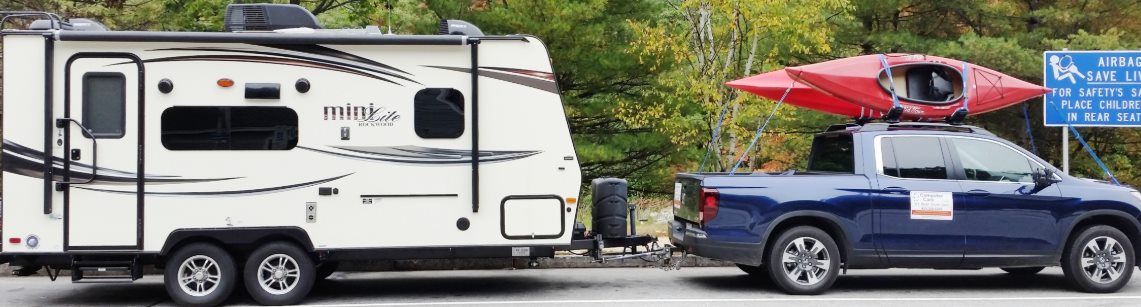
Why your vehicle's tow rating matters
Tow rating is the number every part of your vehicle was engineered around. The frame, the cooling system, the brakes, the rear axle, the transmission cooler, even the tail-light wiring harness — all of those were specced to handle a specific maximum trailer weight. Exceed it and you don't just risk a ticket. You risk the transmission overheating on a long climb, the brakes fading on a steep descent, and the whole rig fishtailing in a crosswind because the tow vehicle wasn't built to handle the load it's pulling.
Manufacturers don't pick the tow rating arbitrarily. Since 2015, every light-duty truck and SUV sold in the United States has been tested against SAE J2807, a standardised procedure that includes a 3,500-foot climb up the Davis Dam grade in Arizona at full GCWR with the air conditioning running. The published tow rating is the maximum weight the vehicle can pull up that grade without the cooling system or transmission throwing in the towel. That's the number you have to stay under.
How to read your vehicle's tow rating
Open your driver's door and look at the white sticker on the door jamb. You'll find four numbers that matter for towing:
- Curb weight: what the vehicle weighs sitting on the lot, full of fluids, no people, no cargo.
- GVWR (Gross Vehicle Weight Rating): the maximum the vehicle can weigh including everyone and everything inside it, including the tongue weight pressing down from the trailer.
- GAWR (front and rear): the maximum each axle can carry. Loading a fifth-wheel hitch in the bed of a truck eats rear GAWR fast.
- Tire pressure: the door sticker also tells you the cold tire pressure for towing, which is usually higher than the everyday number.
The big number you also need — GCWR (Gross Combined Weight Rating), the maximum total of vehicle plus trailer plus everything in both — lives in the owner's manual under "Towing", not on the door sticker. GCWR is the constraint that catches people out: you can be under tow rating and under GVWR and still be over GCWR if your trailer plus passengers plus cargo plus tongue weight adds up to more than the vehicle is rated to handle as a combined rig.
The model pages on this site list the manufacturer's published headline tow rating per trim. Browse a make and drill into your year + model to see the breakdown, then cross-check against your specific door sticker because tow package and rear-axle options change the rating.
Hitch classes (the four-hitch matrix)
Hitches are rated in classes. The class determines the maximum trailer weight and tongue weight the receiver can handle:
- Class I — up to 2,000 lb trailer, 200 lb tongue. Fits most sedans and crossovers. Good for a small utility trailer or a single jet ski.
- Class II — up to 3,500 lb trailer, 350 lb tongue. Mid-size SUVs and small trucks. Pop-up campers, single horse trailer.
- Class III — up to 8,000 lb trailer, 800 lb tongue. Half-ton trucks and full-size SUVs. Most travel trailers up to about 24 feet, boat trailers, two-horse trailers.
- Class IV — up to 10,000 lb trailer, 1,000 lb tongue. Heavy-duty receivers on three-quarter-ton and one-ton trucks.
- Class V (gooseneck and fifth-wheel) — 10,000 to 30,000 lb trailer. Hitch is mounted in the bed of the truck, not on the bumper. Required for big toy haulers, large fifth-wheel campers, and most flatbed work trailers.
Tow dollies
A tow dolly is a small two-wheel trailer that lifts the front wheels of a vehicle off the ground so only the rear wheels touch the road. RVers use them to tow a daily driver behind a motorhome — drive the car up the ramp, strap the front wheels in, and the rear wheels coast along behind. Tow dollies are cheap, light (about 500 lb empty), and don't need a base-plate kit installed on the towed vehicle.
The catch: only front-wheel-drive cars work on a dolly. Rear-wheel and all-wheel-drive vehicles either need their driveshaft disconnected or have to ride on a full four-wheel trailer. And most dollies don't have brakes, which means the motorhome's brakes are doing all the work for the combined weight — fine on flat ground, less fun on a long mountain descent.
Bumper-pull (conventional) trailers
The receiver hitch in the rear bumper, a ball mount, and a coupler on the trailer tongue. The most common setup for travel trailers under 8,000 lb, boat trailers, utility trailers, and most horse trailers. Easy to hook up, easy to back into a parking spot, easy to store because the trailer sits flat behind the vehicle.
Tongue weight on a conventional trailer should sit between 10% and 15% of total loaded trailer weight. Less than 10% and the trailer wants to sway; more than 15% and you're overloading the rear axle and unloading the front (which makes the steering go light). If you can't feel the difference between an empty and a loaded trailer through the steering wheel, you've probably got the load wrong — pull over and rebalance.
Weight-distributing hitches
Once you get over about 5,000 lb of trailer behind a half-ton truck or SUV, a plain ball hitch starts to feel sketchy. The tongue weight pushes down on the rear of the tow vehicle, lifts the front, and the whole rig handles like the steering wheel is connected to a piece of string. A weight-distributing hitch fixes that by transferring tongue weight off the rear axle and onto both the trailer axle and the vehicle's front axle, restoring level ride and proper steering feel.
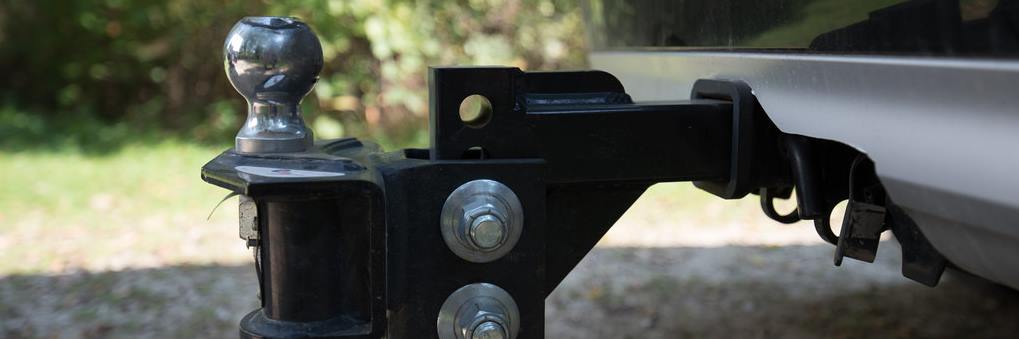
Most modern half-ton trucks publish two tow ratings — a lower one for a conventional bumper-pull and a higher one for a weight-distributing setup. If your manufacturer's rating shows a 7,500 lb conventional and a 11,300 lb weight-distributing rating, you have to actually install a weight-distributing hitch to use the higher number. There's a full explainer on when you need one and how to size the spring bars.
Gooseneck and fifth-wheel
For trailers above ~12,000 lb, the hitch moves into the bed of the truck. A gooseneck uses a ball mounted over the rear axle (you flip a cover open in the bed); a fifth-wheel uses a horseshoe-shaped plate that the trailer's pin slides into. Both put the load directly over the rear axle of the truck instead of behind it, which is why heavy-duty pickups can pull 30,000 lb in a fifth-wheel rating but "only" 18,000 lb on a conventional bumper.
Tongue weight (called pin weight on a fifth-wheel) sits between 15% and 20% of trailer weight. With a 15,000 lb trailer that's 2,250 to 3,000 lb of weight directly on the rear axle of the truck — which is why you can't just bolt a fifth-wheel hitch into a half-ton bed. The truck's rear GAWR has to be high enough to carry it, and that's almost always a three-quarter-ton or one-ton spec.
Loading a trailer so it pulls straight
Sway is the enemy. A trailer that sways at highway speed wants to keep swaying, builds amplitude with each oscillation, and can take the tow vehicle with it. Two rules of thumb prevent it:
- 60/40 weight bias. Put 60% of cargo weight in front of the trailer's axles, 40% behind. That keeps tongue weight in the 10–15% sweet spot and stops the trailer from feeling tail-heavy.
- Pack low and centred. Heavy cargo on the floor, ideally directly above or just ahead of the axles. High cargo raises the centre of gravity and makes crosswind sway dramatically worse.
Re-check tongue weight after every loading change. A bathroom scale under the trailer tongue (with a piece of plywood as a spreader) tells you the actual number — guessing by eye is how people end up overloaded.
On the road
Towing changes how your vehicle behaves in three obvious ways and one less-obvious one. The obvious three: you're heavier (slower acceleration, longer stopping distance), you're longer (wider turning arc, can't see directly behind you), and you're taller in the back (parking garages, drive-throughs, and tree branches all suddenly matter). The less-obvious one: you're more wind-affected, especially with a high-sided trailer like a travel trailer or horse trailer. Crosswinds at 25+ mph can push a trailer around enough to feel like the steering is working through warm syrup.
Three habits that prevent most towing incidents:
- Slow down on grades. Most state highway codes have a lower speed limit for vehicles with trailers — 55 mph is common — and it's set where it is for a reason. Engine braking on a long descent saves your service brakes from fading.
- Leave more space. Quadruple your usual following distance. A loaded trailer needs 50% more stopping distance than the same vehicle unloaded, and brake fade on a long descent makes that worse.
- Don't make sudden lane changes. The trailer follows the tow vehicle with a delay; an abrupt swerve sets up the sway oscillation that kills people.
For more on what to check when buying a used vehicle that you intend to tow with, see the used-car tow rating guide. For the calculator that runs the four real-world checks (tow rating, GCWR, payload, tongue weight) on a specific combination, head to the towing calculator.
All figures and ratings on Tow Ratings are sourced from manufacturer documentation. See our methodology for the full sourcing process.